
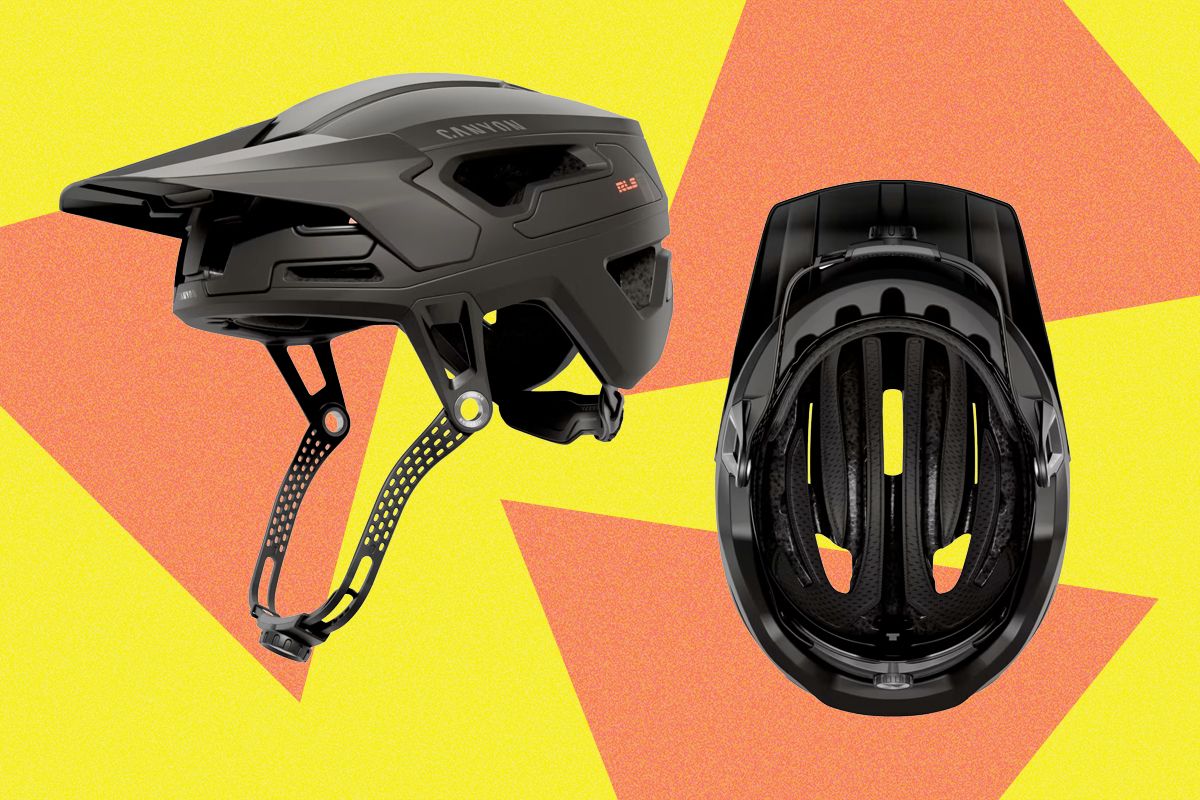
Ever since its inception in the early 2000s, Swedish brand MIPS has had a monopoly, more or less, on inclusion in high-end bike helmets. Its device—revolutionary at the time—deflects rotational impact away from the head in the event of a crash, thereby reducing the likelihood of brain trauma. However, it has also provoked many companies to research and develop their own proprietary rotational impact protection units, most of which are different takes on the same concept—a snug inner webbing that is able to move independently of the helmet’s outer shell.
British brand RLS took a new stance on rotational impact protection, moving its device from the inside of the helmet to the outside. In doing so, the company claims that its technology can reduce the risk of concussion by four times when compared to traditional helmets. Studies at the standard-bearing helmet-safety lab at Virginia Tech University have confirmed those claims, giving the new Canyon Deflectr RLS—the first commercial helmet available with RLS—their highest rating after recent testing.
Peel Away

Photograph: Michael Venutolo-Mantovani
Like any other new technology brand, RLS is hardly new. Its founders and earliest employees spent years toiling in a series of warehouse bays in East London, trying to find a way to better protect against rotational impact. Like all great origin stories, it wasn’t until the eleventh hour, when the brand was nearly out of seed money, that the company decided to try something new and potentially revolutionary: polycarbonate ball bearings.
RLS engineers fastened hundreds of the tiny bearings to adhesive strips, which they then stuck to the outer shells of helmets. Those strips were then covered in another layer of hard helmet shell. Et voila!
The idea behind RLS technology is that when the helmet impacts a hard surface, the ball bearings roll off the strip, forcing the outer layer to shear away from the helmet. Those outer layers release, hence the company’s name, RLS, or “Release Layer System.”
According to data gleaned from thousands upon thousands of internal tests, along with independent testing and verification from labs like Virginia Tech’s, RLS is said to reduce the probability of brain injury by anywhere from 68 percent to 84 percent when compared to a non-RLS helmet.
Chinny Chin Chin
%2520Reviewer%2520Photo%2520SOURCE%2520Michael%2520Venutolo-Mantovani.jpg)
Photograph: Michael Venutolo-Mantovani
A few weeks ago, I visited RLS’s headquarters in their East London warehouses. After they showed me data and analytics, videos of how the RLS system works, and even real-time tests, they sent me home with a Deflectr Trail RLS, marking the brand’s collaboration with beloved German direct-to-consumer brand Canyon.
At first glance, the Deflectr looks like any other mountain bike helmet. It’s bigger and bulkier than a typical road or commuter helmet, with added protection for the basal skull and a sun-blocking visor. On closer inspection, a series of panels, slightly raised from the helmet’s surface, becomes apparent. Beneath these panels is where the genius of the RLS system lives.
In practice, the Deflectr worked just fine. It fit well, thanks to its dial-adjust fit system. At 326 grams, it didn’t put added strain on my neck over the course of a few long trail sessions.
Despite the potentially revolutionary technology that lives just beneath those outer shell panels, the Deflectr RLS is just an off-road bike helmet. The only strange choice here is the chin strap, which Canyon calls its HighBar System. Unlike your typical strap, wherein a pair of nylon strips are fastened beneath your chin, the Deflectr features a stiff (though relatively pliable) plastic band that pulls down from the front of the helmet and under your chin, and uses a dial system to tighten to fit.
I think most helmet straps work just fine. Still, the HighBar System means that the rider can make one-handed strap adjustments on the fly, sometimes while riding. Anyway, once I had the helmet on and fastened to my head, I forgot about the helmet’s strap system entirely.

Photograph: Michael Venutolo-Mantovani
Over the course of several hours and a few dozen trail miles, I had little to say about the Deflectr RLS, which is precisely what you want in a bike helmet. In other words, when a bike helmet is well made, it’s something you should forget is there.
Other than the odd choice of strap (which, as I mentioned, I got over quickly), the only knock I have is how the Deflectr RLS is, as of this writing, only offered in one of two color options: matte black or metallic olive. While those are both cool and all, those of us who ride beneath the brutal southern sun know the value of a white or light-colored helmet.
The sample helmet I was sent came in a really interesting blocky black/white color combo that both looked cool and went a bit further in keeping the temps around my skull down. Here’s hoping there are more color options on the horizon. According to Canyon’s website, the massive vents at the top of the Deflectr, combined with the large intake and exhaust vents work in tandem to keep your head cool. Still, sometimes, in the dead of summer, white can be a rider’s best friend.
According to RLS, the Deflectr is just the first in what will soon be a line of bike, motorcycle, climbing, and even construction helmets. And at just $160, it’s significantly easier on the wallet than some of its contemporary high-end helmets, which can easily run into the $300 range.