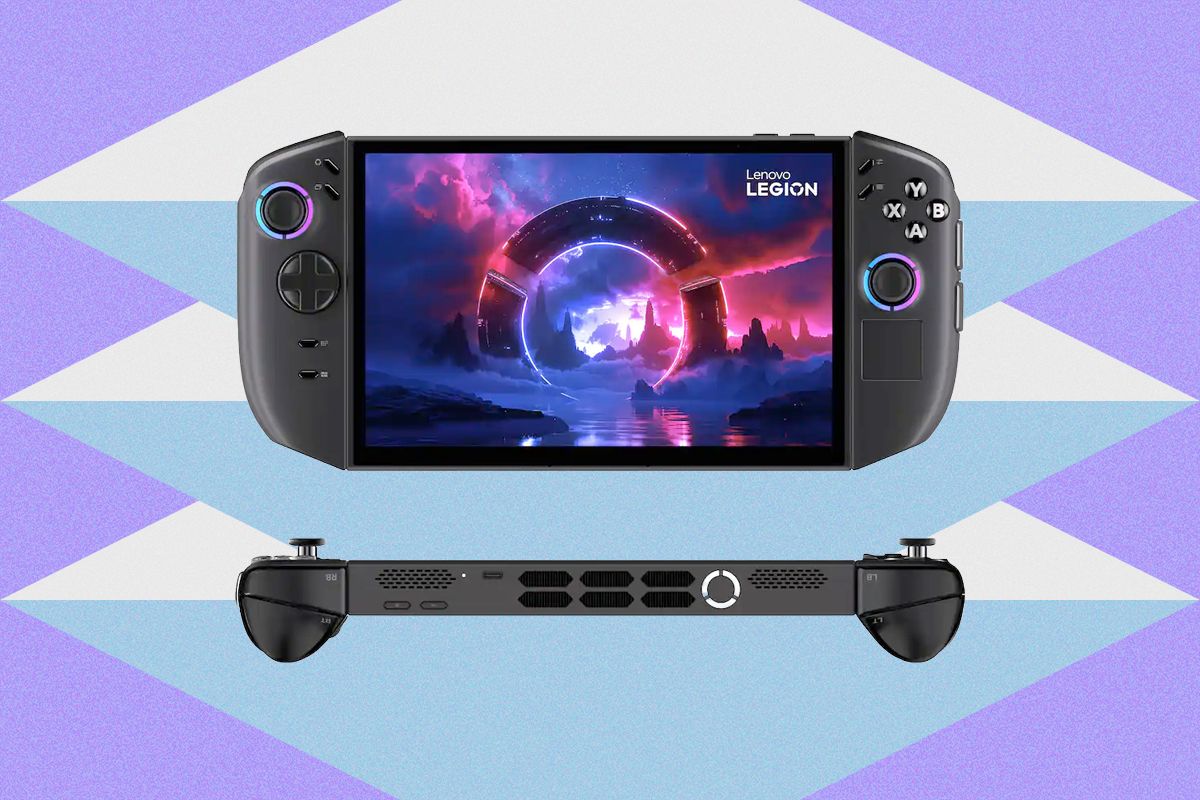
The detachable controllers go a long way towards making the device more portable and usable. The screen has a hefty flip-out kickstand on the back, so I’ve found it more comfortable to park the console on the table or bar in front of me, and hold the controllers at lap level. The upside to the substantial build is that the controllers have comfortable built-in grips, with smooth magnetic Hall effect sticks, and buttons that have a soft, yet distinct touch.
There are also two minor inclusions here that I think do a lot for the user experience. The first is the included case, which might not sound important, but often these handheld gaming consoles don’t include one. Because they aren’t standard-sized, it’s often hard to find a third-party case, particularly at release. While I wouldn’t necessarily trust the semi-soft pouch to protect my new device in a checked bag, I’m totally comfortable tossing it in my backpack and going for a bike ride, and I appreciate that there’s a little spot for the FPS mode accessories inside. The other feature is the fingerprint sensor, which works consistently and quickly, and is much easier than trying to type in a password on a touchscreen every time you wake the system up, although it is in a slightly awkward position.
Game On
The performance on the AMD Z2 is thankfully much better than the Z2 Go found in the Legion Go S. At native resolution, with settings maxed but ray tracing off, I was sitting at 20 FPS in Cyberpunk 2077’s benchmark. That might sound rough coming from desktop numbers, but it’s somewhat impressive for a gaming handheld. For reference, the Z2 Go only managed 20 FPS with the graphics set to low at the same resolution. With a little tweaking or a resolution drop, you could easily break 60 FPS in one of the more demanding modern games.
On indie titles like the recently released Ball x Pit, the meter stays glued to the screen’s 144-Hz limit, which is great news, since you’ll regularly be able to take advantage of the smooth refresh rate. The panel itself is OLED, and it’s one of the best gaming handheld screens I’ve tested yet, with full, vivid colors and deep, dark black levels. It measures a full 336 nits at max brightness, but more impressively, covers 100 percent of the sRGB and 94 percent of the AdobeRGB spectrums, with a .86 color accuracy delta. That color coverage and accuracy is up there with some of the best laptops and dedicated computer monitors. It’s a delight to play on, and despite its glossy finish, I didn’t have any game-breaking issues with heavy reflections or glare.